
What Is A Contact Lens Fitting?
For those who wish to wear contacts, it's important to remember that the standard prescription provided by eye care practitioners is generally only for eyeglasses. There are additional measurements that must be taken in order to get the right lenses for your needs.
Every eye is different - your left is slightly different from your right, and your eyes are different from those of everyone else around you. Differences include the diameter and the curvature of your eye, not to mention the severity of any vision problems that you might have. This is why getting a precise contact lens fitting is so important.
Do I Need A Contact Lens Fitting?
If you wear, or want to wear contact lenses, you will need a contact lens exam in addition to a comprehensive eye exam. Your Optometrist or eye doctor will perform special tests during a contact lens exam to evaluate your vision with contacts.
So, if you have problems with your vision and want to use contacts to correct the problem or if you wish to get coloured contacts for cosmetic purposes a contact lens fitting is needed. An improper fitting of or prescription for contacts can damage the health of the eyes.
What Happens During A Contact Lens Fitting?
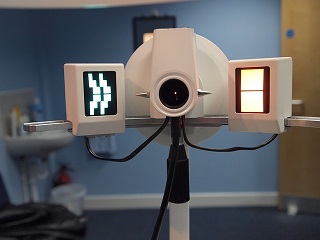
A contact lens fitting is a specialised exam to determine if you are suitable for contact lenses, your Optometrist or eye doctor will perform a test specific for contact lens wearers-
- Determine the health of your eyes.
- Take measurements of your eyes.
- Evaluate your tear film.
- Discuss what you want from contact lenses.
- Make notes.
Your contact lens exam will normally begin with your Optometrist determining the overall health of your eyes. Your corneas (The clear outer layer at the front of the eye, that helps your eye to focus light so you can see clearly.) will be examined, using a instrument called a slit lamp, to ensure that they are healthy enough for wearing contact lenses.
The next step will be to take careful measurements of your eye using a special instrument called a keratometer. Your eyes may also be scanned by a computer to map the curvature of the surface of your eye and to provide a more detailed analysis. These dimensions will determine the shape and size of your lenses.
In addition, a contact lens fitting could also include a test to evaluate the tear film on your eyes. The specialist may also ask if you have any allergies, hay fever or dry eyes and enquire about your lifestyle. All of this information will help the eye care professional determine how prone your eyes are to dryness, and help to ensure that you choose a contact lens type that suits your needs.
During the contact lens fitting the Optometrist will also inquire as to why you want contact lenses - are they for occasional use, full-time use, for sport or some other specific activity? Do you want the convenience of daily lenses or are you happy to clean and store monthly lenses every night? Do you want to sleep in your contact lenses for 30 days at a time using continuous wear lenses? Would you like to change your eye colour with coloured prescription lenses? If you are over 45, you may be recommended multifocal contact lenses to help you with reading.
Your eye care specialist will also make a note of the condition of your eyes to refer back to on future visits to ensure that your ocular health hasn't deteriorated due to wearing lenses.
What Is A 'Contact Lens Trial'?
A contact lens trial happens once the Optometrist has determined the best contact lenses for you, he/she will provide a pair of contact lenses for you to try out for 20 - 30 minutes before carrying out more tests to confirm the size and power of the lenses are right for you.
During the initial part of the contact lens exam, the Optometrist will have gathered enough information to recommend a particular type of contact lens to you - one that satisfies all of your (and their) criteria to achieve the best chances of success.
Normally the Optometrist will have 'fitting sets' available in the practice, which are sets of contact lenses provided to him by the main contact lens manufacturers, from which he will choose the brand and power that he/she wants to try.
The Optometrist will insert the contact lenses into your eyes - don't worry this is a simple procedure and he/she will have done this many times before. After a check to ensure you are comfortable and can see well enough, you will be asked to either wait outside the consulting room or walk around for 20-30 minutes to let the contact lenses settle down in your eyes.
On returning the Optometrist will ask you how the trial has gone, from your perspective. Any discomfort? How is your vision?
The Optometrist will then check your vision wearing the contact lenses and he/she will perform something called an 'over-refraction'. Here he/she will work out how much extra power you need in your lenses to see clearly, they will also check the fit of the contact lenses using a instrument called a slit lamp. Basically a large horizontally mounted low power microscope.
Finally, they will remove the contact lenses and will probably put a non-stinging dye into your eyes and once again check your corneas using Ultra Violet light to make sure there are no scratches or other anomalies.
If all is normal, the Optometrist will normally arrange for a 'Handling session' if the contact lenses are in stock this could be carried out immediately if not the contacts will be ordered in, and arrange for a 'Handling session' at a later date.

What Is A 'Handling Session'?
In a handling session you will be taught how to handle your contact lenses this is normally carried out by a staff member who is trained in this area, you will be taught:
- How to insert and remove your contact lenses.
- How to care for and clean your contact lenses,
- Basic hand hygiene techniques,
- Tips and advice, eg. How to tell if your contact lens is 'inside out'
- Given a wearing schedule i.e. 4 hours on the first day and increase by 2 hours per day to a maximum of 14 hours.
Finally, you will be scheduled for an 'aftercare' appointment, usually after two weeks. At this appointment, you will get a chance to ask the Optometrist any questions that you have about your contact lenses. They will recheck the fitting and vision and generally make sure that everything is normal. At this stage, the Optometrist may make slight adjustments to the power and issue a final Contact Lens Prescription.
Can I Buy Lenses Online After My Contact Lens Fitting?
Once you've had a proper contact lens fitting and been taught how to handle them, you can choose to get your contacts from any supplier, whether online or from another high street optician, you are not contracted to buy your lenses from the Optometrist who fitted them.
Once your contact lens fitting is complete your Optometrist should provide you with a copy of your contact lens prescription, this may take a few weeks or even a couple of months, according to the College of Optometry "The fitting period will usually be less than three months, and can vary depending on:
- Lens type
- How quickly you adapt to the lenses
- The likelihood of a change in your ocular health
- Other clinical findings
Your Optometrist must tell you if the fitting will take longer than expected and record the reasons for this on your records.
When the fitting is complete, the Optometrist must give the patient their contact lens specification.
Your contact lens prescription will clearly identify the Brand, Fitting and power of your contact lenses.
On our website, we offer a wide range of lenses from leading brands and at affordable prices.