What is hypermetropia (farsightedness)?
Hyperopia or farsightedness can also be called hypermetropia, or long-sightedness, they are all different names for the same condition: a vision problem that causes objects close to you to be blurred, and objects at a greater distance to be clear. The condition is caused if an eye is shorter than normal, or a cornea is not as curved as it should be.
Eyes that are slightly misshapen won't be able to focus light accurately onto the retina at the back of the eye, which results in blurred vision.
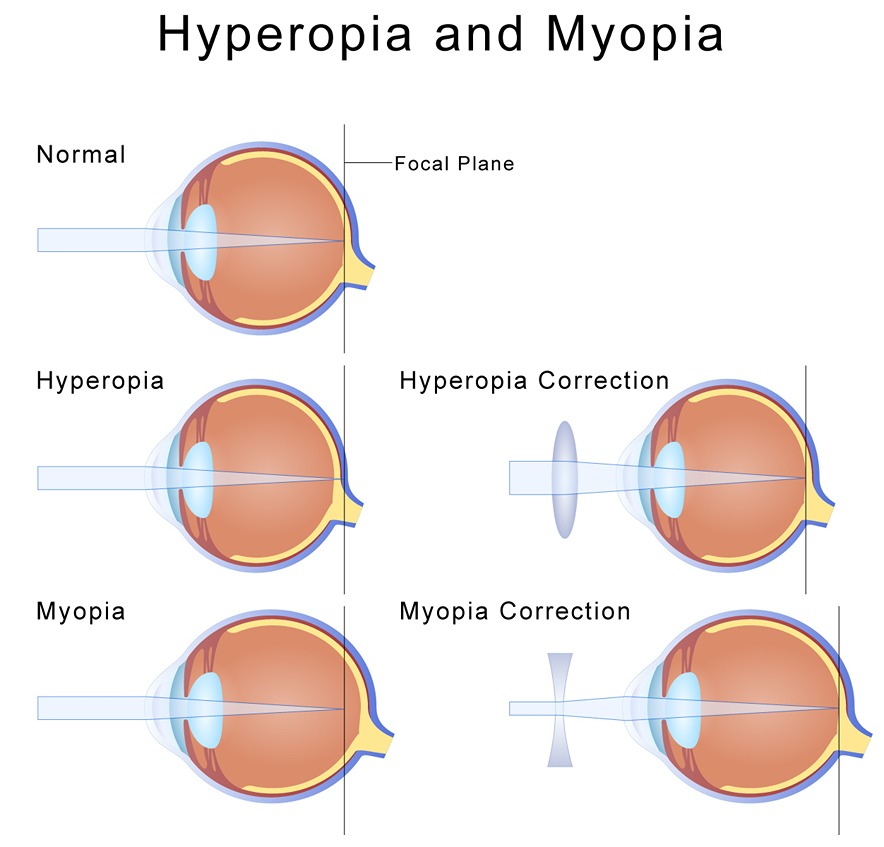
There are several kinds of irregular shapes that an eye can take, each moving the focal point of the light away from the retina, resulting in a different form of vision impairment. When the shape of an eye focuses light behind the retina this causes hyperopia, and when the light is focused in front of the retina, the resulting condition is called myopia, or nearsightedness. Corrective lenses are available for both conditions, and are designed to move the focal point to the surface of the retina, restoring clear and focused vision.
Our Optometrist's Advice
"Hypermetropia, or long-sightedness, is one of the most common refractive errors we diagnose and, fortunately, one of the easiest to correct. If you're finding reading, computer work or other close-up tasks increasingly difficult, don't simply assume it's a normal part of ageing. A comprehensive eye examination will determine the exact cause and allow us to recommend the most suitable solution, whether that's glasses, contact lenses or, in some cases, refractive surgery."
- Mr J Dreyer BSc (Hons), MCOptom, DipCLP
What Causes Hypermetropia?
There is no definite cause identified for farsightedness to this day. Hypermetropia is largely hereditary but can develop in anyone. It's possible to experience symptoms during childhood, but it is much more common later in life. In fact, anyone above the age of 40 has a much greater chance of experiencing symptoms of hyperopia, with the likelihood growing every year. Ageing doesn't necessarily cause the eyes to change shape anymore, but it does diminish the eye's ability to flex enough to accommodate for the refractive error. Additionally, some forms of hyperopia can be caused by injury, drugs, or disease.
It's common for farsightedness to be confused with presbyopia. Both conditions have similar results - difficulty focusing on objects that are near - but they have different causes.
What are the Symptoms of Hypermetropia?
Everything may seem clear and in focus when viewing at a distance more than a few meters away, but any closer than that and things may start to get blurry. The closer they get, the less focused they become.
Someone experiencing hypermetropia may experience
- Difficulty focusing on reading and writing
- Squinting
- Eye strain
- Headaches
If you're experiencing any of these symptoms, it's recommended that you make an appointment with an eye care professional. A comprehensive eye exam should help determine the cause of these symptoms, and what steps can be taken to get it resolved.
Are there Different Types of Hyperopia?
There are several different categorisations of hyperopia, depending on the root causes and how advanced the condition has become. Below are the four main forms of hyperopia.
- Latent Hyperopia – When it is in its early stages, and not yet fully developed. At this point, symptoms are just beginning to appear, and may not even be noticeable unless actively looking for them. It's at this stage where even a small amount of squinting is enough to correct the blurry vision.
- Low/Moderate/High Hyperopia – Once the condition becomes more developed, it can grow to three different levels of severity. Low hyperopia will have the least drastic change in eyesight, with a prescription measurement of +2.00D or below. Moderate hyperopia, follows next, with prescription measurements between +2.25 and +5.00D. Finally, High Hyperopia will have the greatest effect on vision, and have prescription measurements of +5.25 or higher.
- Pathologic Hyperopia – Caused by irregular development of the structure of the eye, injury to the eye, or disease. Some diseases that can possibly lead to hyperopia are cataracts, microphthalmia, anophthalmia, and aniridia.
- Functional Hyperopia – Unlike other forms of hyperopia that are caused by an irregularly shaped eye, this form is caused by a failure of the muscles around the eye that would normally allow it to focus.
How is Hypermetropia Detected and Treated?
Hypermetropia is normally first detected in a basic eye test, your Optometrist will ask a series of questions about your vision and eye health, and then perform an eye test and examination, this is where it will be determined whether you have hypermetropia (longsighted) or Myopia (short sighted) and/or astigmatism.
Corrective eyeglasses, contact lenses, and even surgery are all potential treatments for farsightedness and can all help to restore clear and focused eyesight. Each form of treatment has its own advantages and disadvantages, lifestyle, work environment, and personal preference all play a role in deciding which is best. You should discuss with your eye care professional which one is right for you.
- Eyeglasses are inexpensive and effective, but not always convenient. If you have an active lifestyle or play sports, it may be difficult to keep them firmly in place. They come in many different shapes and sizes and can be quite fashionable. With so many options available, it may take some time to find a pair that's comfortable, but the right ones will feel like they aren't even there. Tinted lenses are also available, allowing you to stay protected from bright sunlight and damaging UV rays.
- Contact Lenses are much more subtle, providing no change in your personal appearance at all (unless you're looking to change your eye colour). They are designed to be worn all day long, and removed at night. Different types of lenses can be worn for varying lengths of time. Some last for several weeks before needing to be replaced, while others are worn only for a single day before being disposed of. With proper hygiene and some practice, contact lenses are one of the more versatile options for people looking for corrective eyewear.
- Surgery is also an option. LASIK and PRK are two examples of surgical methods that reshape the surface of the eye, allowing it to refract light accurately without any need for corrective lenses. This is a more expensive method of fixing the problem, but it's also more permanent. The recovery time is usually only a few days, but only one eye is corrected at a time, so more than one visit will be required.
For mild cases of this condition, you may only need to wear your corrective lenses when doing tasks at close range - such as reading or using a computer. Those who have more severe farsightedness, or who suffer from other conditions like astigmatism, may need to wear their lenses more often.
It's also important for everyone to get their eyes checked on a regular basis, it is recommended to get your eyes tested every 2 years, because vision problems tend to slowly develop over time. For those diagnosed with farsightedness, this will enable your eye care professional to monitor your condition and make adjustments to your corrective lenses prescription as appropriate.
During your eye examination, you should be advised on how often you should wear your lenses to correct your hypermetropia. You'll probably be asked questions about your lifestyle and the type of work you do in order to determine the best way of dealing with your farsightedness.
Can Contact Lenses Correct hypermetropia?
If you have been diagnosed with hypermetropia or farsightedness and need corrective lenses, contact lenses could be the perfect choice: they are safe and easy to use and don't have any effect on your appearance.
On our website, we offer a range of contact lenses that will help farsighted individuals see clearly. And with our simple and fast service, you can order your new contact lenses without ever leaving the comfort of home.