Presbyopia - the Ageing Eye
Presbyopia is a visual condition that most people will eventually experience, as we age we will find it increasingly difficult to focus on objects or writing close up. The term is derived from the Greek word presbys, which means old man. This is an apt name, as the condition appears - like grey hair and wrinkles - as part of the ageing process.
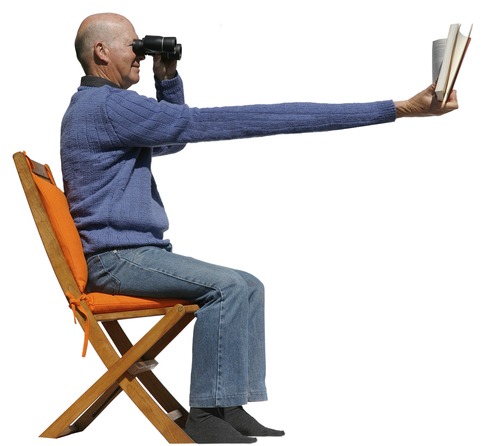
Sometime around the start of middle age, you may feel that your arms aren't quite as long as they used to be. You may start holding books farther and farther from your face or you may notice it's getting harder and harder to see the type on your mobile. While you'll want to see an Optometrist for a proper diagnosis, this condition is extremely common and affects the vast majority of people lucky enough to live a long life.
What Is Presbyopia?
Presbyopia is an eye condition that makes it harder to focus on objects close to you. This usually begins to happen within a few years of your fortieth birthday but can happen at any point in your life. If you are already quite near-sighted, you may not notice presbyopia initially, thinking your eyes are improving, but eventually everyone ends up needing reading glasses, it is estimated over a billion people worldwide have presbyopia
Presbyopia is also known as age-related farsightedness or age-related long-sightedness. Objects that are far away are easier to focus on but objects closer to your eyes may become blurry or smeary. You may also experience tired eyes, eye strain, or headaches as the condition progresses.
What Causes Presbyopia?
Behind the clear cornea of your eye is a natural lens, this lens is flexible when we are young, making it easy to focus on objects both near and far. As we age, the elasticity of this lens begins to wear and it becomes more rigid.
Research also suggests that presbyopia may be caused by a change in the lens's curvature. And since the lens continues to grow throughout a person's life, it's thought that the combination of the lens's larger size in later life, coupled with the loss of strength in the small muscles in the eye - called the ciliary muscles - could be another factor leading to presbyopia. Presbyopia can develop suddenly or over a period of time. As the condition progresses, you will find it harder and harder to focus on printed words in books, menus and magazines, especially in dim light and with smaller text.
Presbyopia Treatment Options
Presbyopia may sound absolutely awful and you may be feeling anxious about life without crisp, clear, close vision but you are not alone. There is a great website dealing with all issues presbyopia-related that can be found here.You may have many questions, How will you read books or use hand-held electronic devices? Will you be forced to give up hobbies such as tying fishing lures, completing jigsaw puzzles or sewing? There's good news! You will be able to enjoy sharp close vision well into advanced age because treatment is available.
Whether you choose to pursue glasses, contact lenses or surgical treatment, presbyopia can be managed.
- Reading glasses are a very popular option for treating presbyopia. If you don't wear glasses normally, you may be surprised to note just how clear your close vision can be with a pair of reading glasses.
Reading glasses use magnification to make objects close to you seem larger. Of course, you don't want to drive with readers on! You will need to wear your reading glasses for close work and you will learn over time when you need to wear them and when to remove them. Some people wear their readers on a neck chain, while others push them up onto their heads when not in use. Some reading glasses are only half-lenses so you won't need to constantly put them on and take them off when switching between tasks. - Bifocal glasses or Varifocal glasses are a great option if you already wear glasses for vision correction throughout the day. Bifocals are made so that the bottom section of the lenses provides the magnification you need to see up close. By tilting your head up and looking out the bottom of the lenses, reading small print will be simple once more. By lowering your chin, you are looking out through your usual prescription. If you're worried that the line of bifocals will make you look old, no-line bifocals are a popular option. No one has to know you wear bifocals, as it's impossible to see any difference in no-line varifocal glasses unless you are wearing them.
Many people don't like the glasses option as they feel wearing reading glasses can make them feel or look "old", fortunately, contact lenses are a great option for many people dealing with presbyopia. - Contact lenses offer several different options for treating presbyopia. The three main options include:
- Multifocal contact lenses. "Multifocal" is a catch-all term used to describe contact lenses that have different powers of vision in the same lens. Some examples of multifocals include concentric lenses, aspheric lenses and translating lenses. All of these lens types are designed to give you a clear field of vision in near, far and middle distances by shifting your gaze. Multifocal contact lenses work on a 'simultaneous vision principle' in that both distance and near vision are in focus at the same time, and you learn to ignore one and see the other, depending on the task at hand. Multifocal lenses can come with a centre near or a centre distance design, and your optometrist will judge which is best for you. Many people are able to adjust to a multifocal lens within a few days. Others will not be able to tolerate them and may need to try alternative methods.
Multifocal contact lenses now come in Dailies i.e. Dailies Aquacomfort Plus Multifocal or 1 Day Acuvue Multifocal, in monthly formats i.e Biofinity Multifocal or even extended wear multifocal lenses that you can wear overnight for example Purevision Multifocal.
Multifocal contact lenses require careful fitting by an Optometrist in order to get the correct powers to enable you to see comfortably at all distances. Sometimes the Optometrist can make the smallest change to a power, either distance or near in the contact lens, and this can have a large impact on the quality of the users' vision. Aftercare appointments to make these adjustments are very important to the overall chance of success. - Inducing monovision with contact lenses. Another treatment method involves training one eye to be nearsighted and the other eye to remain farsighted. This is accomplished by over-correcting vision in one eye with a contact lens. While this may sound nauseating, the brain quickly learns which eye is for which task. Adaptation is usually quick and hassle-free. If you're still having problems adjusting after a week or so, check in with your Optometrist. Some people will not adapt to monovision.
If you already have good vision and don't wear correction at all when presbyopia develops, inducing monovision with a contact lens in one eye may be the simplest way to give you back your close vision. - Modified Monovision. Here you wear a multifocal contact lens, usually in your non-dominant eye, which is adjusted by the Optometrist to give better near vision, with some compromise in the distance, and wear a standard distance lens in the other eye. If you don't read a lot or do not do a lot of close work, this can be an ideal solution.
There is a fourth option which is a combination of contact lenses plus a pair of reading glasses. If you spend hours a day reading, doing needlepoint, writing by hand or doing other close work, it may make sense to wear close-vision glasses over the top of your distance contact lenses when you are doing extended near tasks.
Surgery
There are other options for correcting your presbyopia.- Lasik Surgery: If you have already adapted well to monovision sight, you can receive LASIK surgery to make the monovision permanent.
- Kamra Implant: There is an exciting new procedure available called a Kamra implant. This implant is small and extremely thin, yet restores close vision while leaving distance vision intact. The Kamra lens is only inserted in the non-dominant eye, making it another form of monovision.
- Monovision Conductive Keratoplasty: Another surgery that induces monovision permanently is the Monovision Conductive Keratoplasty which works by activating collagen fibres that reshape the cornea.
- Refractive Lens Exchange: is another surgical technique used to combat presbyopia wherein new lenses are inserted in place of your natural lenses behind the corneas.
There are so many surgical options available, that it makes sense to speak to your optometrist if you're considering surgery. Each procedure has its own set of parameters, benefits and drawbacks to consider.
How Will I Know What Correction Method Is Best For Me?
Choosing which method is best for you depends a lot on your particular circumstances and your personal preferences. Some people do not like eyeglasses on their faces, especially if they've never worn glasses before. Others cannot get used to contact lenses, or are not keen on touching their eyes. Others don't like the idea of surgery on such a sensitive and vital body part. Your optometrist can work with you to discover what methods you're comfortable trying, it's not at all uncommon to need to try a few different solutions before finding the one that's best for you.
As you can see, there are many different options available for treating this perfectly normal part of the ageing process. With so many options available, there's no need to go through life holding reading materials at arm's length or giving up your favourite hobbies. Speak to your Optometrist about the options he or she would recommend. There's no reason to suffer from poor vision when correction is often just an eye test away.