
Decode your contact lens prescription
Your contact lens prescription can look confusing at first. Alongside familiar numbers showing the power of your lenses, you may see abbreviations such as BC, DIA, CYL, AXIS and ADD.
Each tells you something different about the contact lens that has been fitted for your eyes. Some describe the power needed to correct your vision, while others relate to the size, shape or design of the lens.
Unlike a glasses prescription, your contact lens prescription identifies the contact lenses you have been fitted with. In the UK, a contact lens specification should contain enough information for the fitted lens to be identified and replicated.
The good news is that once you understand a few abbreviations, reading it becomes much easier.
Reviewed by John Dreyer BSc (Hons), MCOptom, DipCL – Optometrist & Clinical Content Reviewer
Contents
What Do the Numbers on Your Contact Lens Prescription Mean?
| Abbreviation | Meaning | What It Tells You |
|---|---|---|
| SPH / PWR | Sphere / Power | The lens power used to correct short- or long-sightedness |
| BC | Base Curve | The curvature of the contact lens and part of its fitting specification |
| DIA | Diameter | The overall diameter of the contact lens |
| CYL | Cylinder | The amount of astigmatism correction required |
| AXIS | Axis | The orientation of the astigmatism correction |
| ADD | Addition | Additional power used in multifocal lenses for near vision |
You won't necessarily see all of these on your prescription. CYL and AXIS are associated with toric contact lenses that correct astigmatism, while ADD will appear when you have been fitted with multifocal contact lenses.
An Example UK Contact Lens Prescription
A UK contact lens prescription or specification may contain information for your right and left eyes, including the lens brand or design, power and fitting measurements.
For example, a toric contact lens prescription will normally include CYL and AXIS as well as sphere power because these measurements are required to correct astigmatism.
The BC and DIA describe dimensions of the fitted contact lens, while SPH, CYL, and AXIS describe the optical correction required.
A multifocal contact lens prescription may also include an ADD, which indicates the additional near-vision correction required for presbyopia.
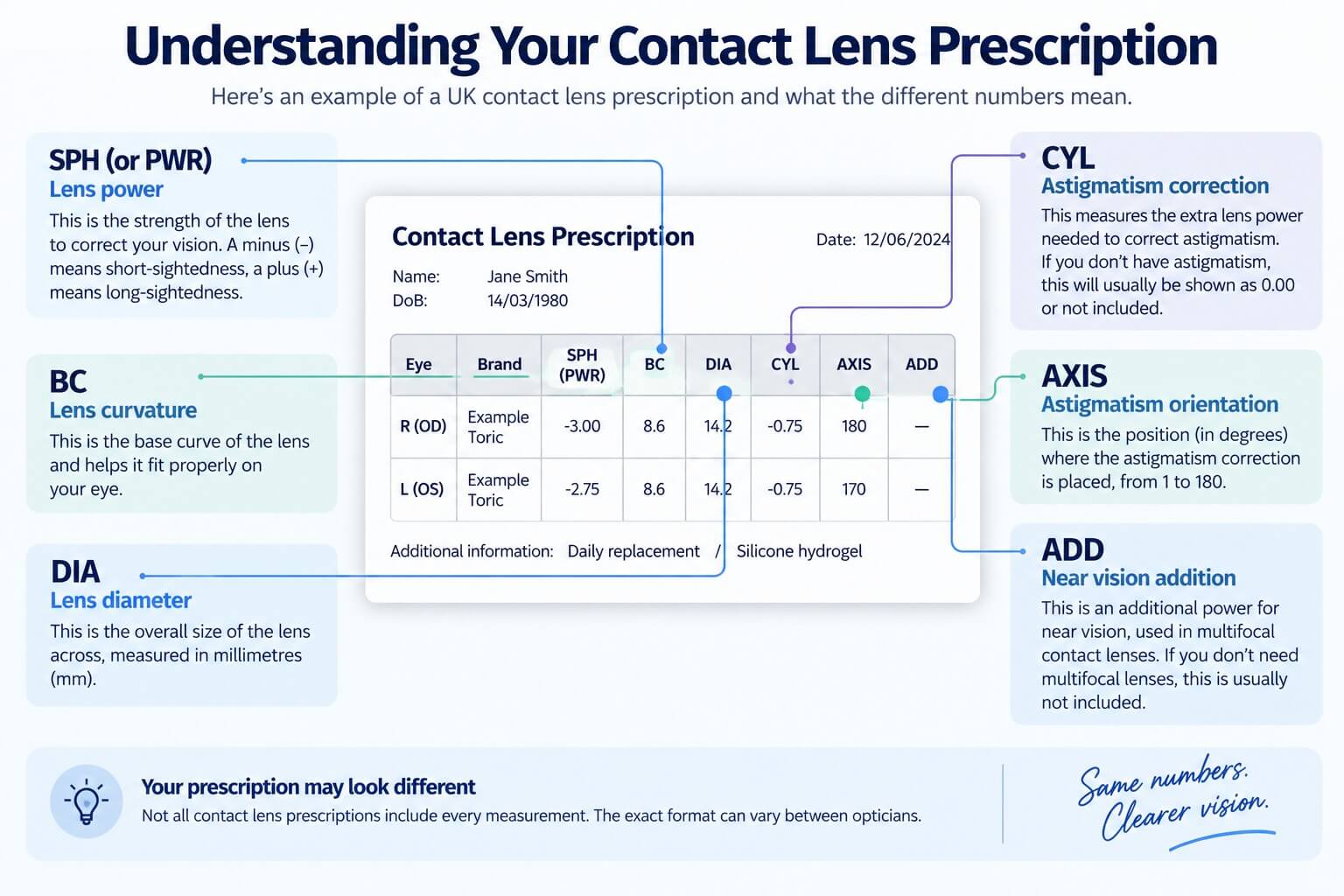
Your Prescription May Look Different
Don't worry if your own contact lens prescription doesn't contain every measurement shown in our example. A straightforward spherical prescription, for example, won't normally require CYL and AXIS, while ADD is relevant to multifocal correction.
The layout and terminology can also vary between optometrists and contact lens manufacturers. You might see PWR rather than SPH, for example, but the underlying information serves the same purpose.
Contact Lens Prescription or Contact Lens Specification?
You may hear the terms contact lens prescription and contact lens specification used when referring to the details of your fitted lenses.
In the UK, contact lens specification is the professional term for the written specification issued after your contact lens fitting is complete.
Throughout this guide, we'll mainly use contact lens prescription, as this is the term most people recognise when checking or ordering their lenses.
Our Optometrist's Advice
“Your contact lens prescription contains more than the power needed to correct your vision. It also identifies the lens you have been fitted with. Base curve, diameter and, where required, cylinder, axis or ADD all help describe the lens you need.
Don't assume that your glasses prescription or the specifications from another contact lens can simply be substituted. If you're unsure what any part of your prescription means, ask your optometrist before ordering.”
John Dreyer BSc (Hons), MCOptom, DipCL
Optometrist & Clinical Content Reviewer
Your Contact Lens Prescription Explained
Now that we've looked at an example prescription, let's take each measurement in turn and explain what it means, why it's included, and when you might see it on your contact lens prescription.
What Does SPH or PWR Mean on My Contact Lens Prescription?
SPH (Sphere) or PWR (Power) tells you the strength of the contact lens needed to correct your vision. You may see either abbreviation on your contact lens prescription or lens packaging.
The number is measured in dioptres (D) and will usually have a plus (+) or minus (−) sign:
- Minus (−) power corrects short-sightedness (myopia).
- Plus (+) power corrects long-sightedness (hyperopia).
For example, a prescription of −3.00D means you need a contact lens with 3.00 dioptres of minus power.
The higher the number after the plus or minus sign, the stronger the correction. For example, −6.00D is a stronger prescription than −2.00D.
Is Contact Lens Power the Same as Glasses Power?
Not always. Your glasses sit a short distance in front of your eyes, whereas contact lenses sit directly on the tear film. Because of this difference in position, the contact lens power can sometimes need to be adjusted, particularly with stronger prescriptions.
This is one reason you shouldn't simply use the SPH value from your glasses prescription when ordering contact lenses. Your optometrist determines the appropriate contact lens power as part of your contact lens fitting.
What Does BC Mean on My Contact Lens Prescription?
BC stands for Base Curve and describes the curvature of the back surface of your contact lens. It is measured in millimetres (mm) and is one of the measurements used when fitting a contact lens to your eye.
You might see a base curve such as 8.4, 8.6 or 8.8 on your prescription and contact lens box. In general, a lower BC number indicates a steeper curve, while a higher number indicates a flatter curve.
Base curve helps your optometrist select a lens that sits appropriately on your eye and provides the movement, stability, and comfort required for healthy contact lens wear.
Does the Same Base Curve Mean Two Contact Lenses Will Fit the Same?
Not necessarily. An 8.6 BC in one contact lens doesn't automatically fit in exactly the same way as an 8.6 BC in another. Lens diameter, material, thickness and overall lens design can all influence how a contact lens behaves on the eye.
This is why you shouldn't switch to a different contact lens simply because its BC and power appear to match your prescription. A different lens may need to be assessed and fitted by your optometrist.
What Does DIA Mean on My Contact Lens Prescription?
DIA stands for Diameter and refers to the overall width of the contact lens from edge to edge. It is measured in millimetres (mm) and forms part of the fitting specification of your lens.
For example, you might see DIA 14.0 or 14.2 on your contact lens prescription and lens box.
Diameter helps determine how the lens sits on your eye and how much of the cornea it covers. Along with base curve, material and lens design, it can influence the way a lens fits, moves and centres on the eye.
Can I Choose a Different Lens With the Same Diameter?
Not on diameter alone. Two contact lenses with the same DIA can have different base curves, materials and designs and may behave differently on your eye.
This is why BC and DIA shouldn't be treated as measurements you can simply match when changing contact lens brands. Your optometrist considers the overall fit and design of the lens, as well as factors such as lens material, oxygen transmission and wearing or replacement schedule, when deciding whether a contact lens is suitable for your eyes and lifestyle.
What Do CYL and AXIS Mean on My Contact Lens Prescription?
If you have astigmatism and wear toric contact lenses, your prescription will usually include CYL (Cylinder) and AXIS as well as your sphere power.
CYL shows the amount of lens power needed to correct your astigmatism. It is measured in dioptres and may appear as a value such as −0.75, −1.25 or −1.75.
AXIS tells the contact lens where that astigmatism correction needs to be positioned. It is expressed in degrees from 1° to 180° — for example, AXIS 90° or 180°.
Because a toric lens needs to keep this correction in the correct position, lens stability and orientation on the eye are particularly important.
For more information, see our Best Toric Contact Lenses for Astigmatism in 2026 guide.
What Does ADD Mean on My Contact Lens Prescription?
ADD stands for Addition and is used with multifocal contact lenses to provide the additional correction needed for near vision, usually as presbyopia develops.
Depending on the contact lens, ADD may be shown as a numerical value or as a category such as LOW, MED or HIGH. Different manufacturers use different multifocal designs and ADD options, so the terminology on your prescription and lens box can vary.
Your optometrist selects the appropriate ADD as part of your multifocal contact lens fitting, taking into account your prescription and your near, intermediate, and distance vision needs.
For more information, see our Choosing Contact Lenses for the Over 40s guide.
Why Is My Contact Lens Prescription Different From My Glasses Prescription?
Your contact lens prescription and glasses prescription are designed to correct the same vision problems, but they are not necessarily interchangeable.
Glasses sit a short distance in front of your eyes, while contact lenses sit directly on the tear film. Because the lenses sit in different positions, the power prescribed for your contact lenses can sometimes be different from your glasses prescription, particularly with stronger prescriptions.
A contact lens prescription also contains information that isn't normally found on a glasses prescription because the lens has to fit your eye as well as correct your vision. Depending on the lens, this may include:
- BC — base curve
- DIA — diameter
- CYL and AXIS — for toric lenses correcting astigmatism
- ADD — for multifocal contact lenses
- The specific contact lens or lens design fitted
- The wearing mode and replacement schedule
A UK contact lens specification contains enough information to identify the fitted lens rather than simply recording the power needed to correct your sight.
Can I Use My Glasses Prescription to Order Contact Lenses?
No. Even if the sphere power on your glasses prescription happens to look identical to the power on your contact lenses, a glasses prescription doesn't contain all the information needed to identify a contact lens that has been properly fitted for your eyes.
If you want to start wearing contact lenses, you'll need a contact lens fitting rather than simply transferring the numbers from your glasses prescription. Your optometrist will assess the lens on your eye as well as your vision, comfort, and other factors relevant to successful contact lens wear.
How to Check Your Prescription Against Your Contact Lens Box
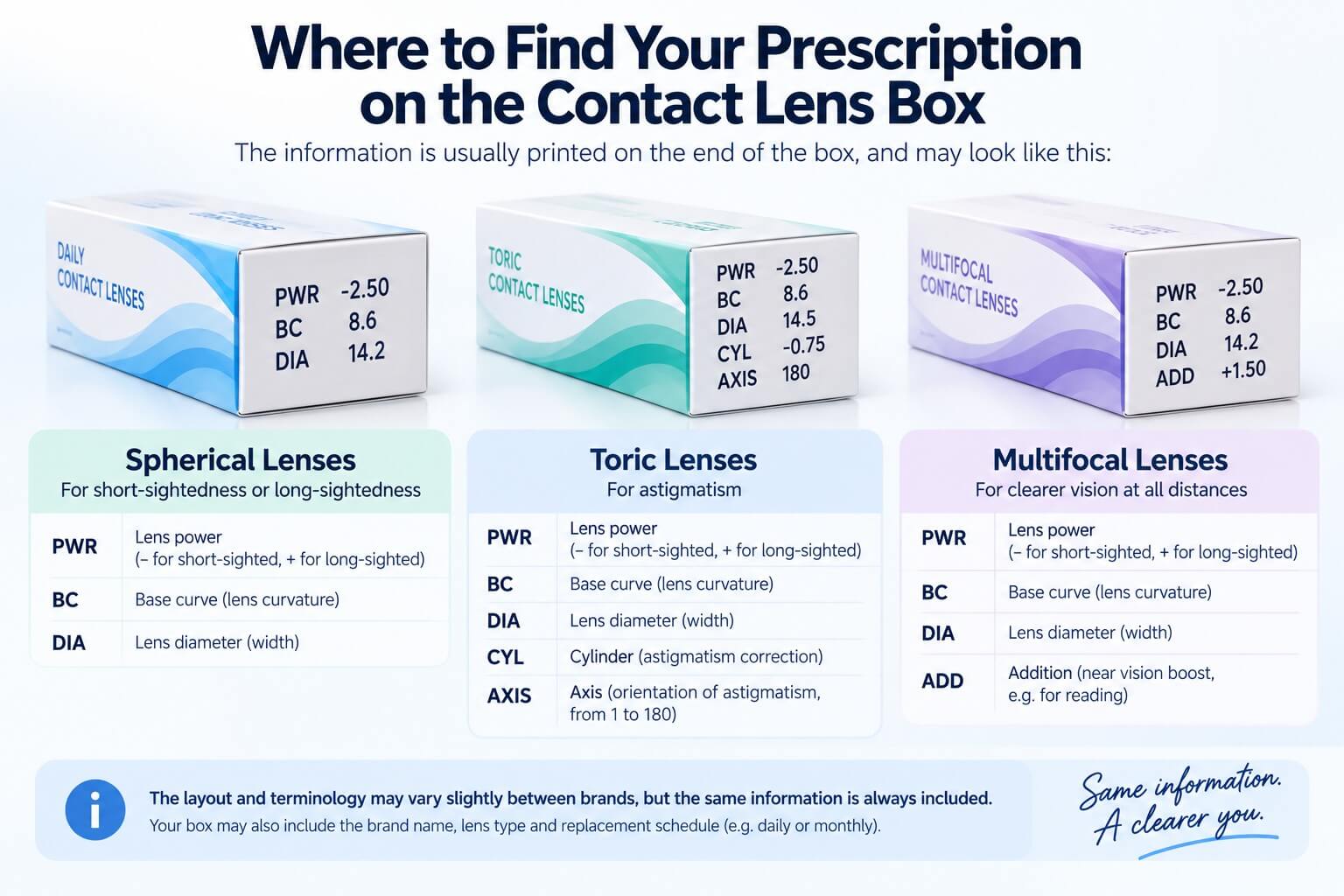
When your contact lenses arrive, the prescription details are usually printed on the end or side of the box. Checking these against your contact lens prescription is a simple way to make sure you've received the lenses and powers you were expecting.
Start by checking the brand and lens type, then compare the prescription details for each eye. Depending on the type of contact lens you wear, you may see:
- Spherical lenses: PWR/SPH, BC and DIA
- Toric lenses: PWR/SPH, BC, DIA, CYL and AXIS
- Multifocal lenses: PWR/SPH, BC, DIA and an ADD value or category
If your right and left eyes have different prescriptions, check each box separately. The power — and with toric or multifocal lenses, other prescription values — may be different for each eye.
What If the Numbers on the Box Don't Match?
If the lens type or prescription details on the box don't match what you were expecting, don't open the individual lens packaging until you've checked your order and prescription. If you're unsure, contact your lens supplier or optometrist before wearing the lenses.
Can I Order Different Contact Lenses With the Same Prescription?
Not necessarily. Even if another contact lens has the same PWR, BC and DIA as your current lenses, that doesn't mean it will fit or perform in the same way.
Contact lenses with apparently identical measurements can differ in material, lens design, thickness, oxygen transmission, and other characteristics that affect how they fit, move and feel on your eyes.
Your contact lens prescription or specification relates to the lens you have been fitted with, not simply a collection of numbers that can be transferred to any brand.
If you'd like to change to a different contact lens, your optometrist can assess whether the alternative is suitable and check its fit, vision and comfort before you switch.
Frequently Asked Questions
Do I Need a Contact Lens Prescription to Buy Contact Lenses in the UK?
Contact lenses need to be professionally fitted in the UK, whether they correct your vision or are zero-powered (plano) lenses, such as some cosmetic coloured contact lenses.
For powered contact lenses, you must have a valid contact lens specification, which is issued once your contact lens fitting has been completed.
Zero-powered contact lenses are also regulated. They should be professionally fitted and supplied by, or under the supervision of, a registered optometrist, dispensing optician or doctor.
So even if a contact lens has no prescription power, you shouldn't treat it like an ordinary cosmetic product that can simply be chosen by appearance or size.
How Long Is My Contact Lens Prescription Valid For?
There isn't one standard validity period for every contact lens prescription. Your prescription should include an expiry date, which your optometrist determines using professional judgement.
This will normally relate to when your next contact lens review is due and may take into account your lens type, wearing mode and individual clinical needs.
Once the prescription has expired, contact lenses shouldn't be supplied against it.
Why Doesn't My Contact Lens Prescription Show CYL and AXIS?
If you wear standard spherical contact lenses, you won't normally need CYL and AXIS. These measurements are used when a toric lens is prescribed to correct astigmatism.
So if you've compared your prescription with our toric example above and noticed that these fields are missing, that isn't necessarily a mistake — your particular contact lens prescription may simply not require them.
Why Doesn't My Contact Lens Prescription Show an ADD?
ADD is associated with the additional near correction used in multifocal contact lenses, so it won't appear on every prescription.
Even when you do wear multifocal lenses, ADD isn't necessarily written as a number. Depending on the manufacturer and lens design, you may see categories such as LOW, MED or HIGH instead.
Can My Right and Left Contact Lens Prescriptions Be Different?
Yes. It's perfectly possible for your two eyes to require different powers or other prescription parameters.
That's why you should check the details for each eye separately when ordering or receiving your contact lenses, rather than assuming that both boxes should show the same numbers.
What Do OD and OS Mean on a Contact Lens Prescription?
If you encounter OD and OS, they are Latin abbreviations used to identify the eyes:
- OD — oculus dexter — right eye
- OS — oculus sinister — left eye
You may also simply see R and L, or Right and Left, on UK documentation.
Helpful Guides
- How to Read Your Glasses Prescription — understand SPH, CYL, AXIS and the other numbers on your spectacle prescription.
- Best Toric Contact Lenses for Astigmatism in 2026 — learn how toric prescriptions work and how CYL and AXIS affect your contact lens choices.
- Choosing Contact Lenses for the Over 40s — understand presbyopia, multifocal contact lenses and ADD powers.
- Which Contact Lenses Are Right for Me? — explore the different types of contact lenses and which may suit your eyes and lifestyle.
- The Complete Contact Lens Buying Guide UK (2026 Edition) — explore daily and monthly lenses, comfort, dry eyes, astigmatism, multifocals and more.
The Bottom Line
A contact lens prescription can look complicated, but most of the abbreviations are straightforward once you know what they mean.
SPH or PWR tells you the lens power, BC and DIA describe the dimensions of the fitted lens, CYL and AXIS are used for toric lenses, and ADD is used with multifocal lenses.
Your contact lens prescription is more than a set of numbers. It relates to the contact lens that has been fitted for your eyes, which is why you shouldn't use a glasses prescription or simply match the numbers when changing to another contact lens.
If anything on your prescription is unclear, your optometrist can explain what it means before you order your lenses.