
Toric contact lenses, also called contact lenses for astigmatism, have been specifically designed to correct an eye disorder called astigmatism, a common vision condition caused when the cornea or lens of the eye has an uneven curvature.
Astigmatism can cause blurred or distorted vision at different distances, but it doesn't mean you can't enjoy the convenience of contact lenses. Modern toric lenses are available in daily disposable, two-weekly, monthly and extended wear options, with designs that help provide clear, stable vision.
For a fuller explanation of the condition, including its causes and symptoms, read our guide to What Is Astigmatism?
In this guide, we'll explain how toric contact lenses work, the different types available, how to understand your prescription and which lenses may be best suited to your needs.
What Are Toric Contact Lenses?
Toric contact lenses are designed to correct astigmatism, which occurs when the cornea or natural lens inside the eye has an uneven curvature, causing light to focus unevenly. This can result in blurred vision, eye strain or difficulty seeing fine details.
Unlike standard spherical contact lenses, toric lenses have different corrective powers in different parts of the lens. This allows them to correct astigmatism, either on its own or alongside short-sightedness (myopia) or long-sightedness (hyperopia).
Standard spherical contact lenses have the same corrective power regardless of how they rotate. However, toric contact lenses for astigmatism must remain correctly aligned with the eye. They use specially designed stabilisation features to help maintain the correct orientation, allowing the astigmatism correction to work effectively.
How Do Toric Contact Lenses Work?
Toric contact lenses work by correcting the way light focuses inside an eye with astigmatism. Unlike standard spherical lenses, which have the same corrective power throughout, toric lenses have different powers along different directions to compensate for the uneven curvature of the cornea or natural lens.
For this correction to work properly, the lens needs to remain correctly orientated on the eye. If a toric lens rotates too far from its intended position, vision may become blurred or fluctuate, particularly after blinking or moving your eyes.
How Do Toric Contact Lenses Stay in Position?
To help maintain clear, stable vision, manufacturers use specially designed stabilisation features that work with the natural movement of the eyelids and the shape of the lens.
Common designs include:
- Prism ballast: The lens has a slightly thicker area that helps it settle into a stable position on the eye.
- Periballast designs: Similar to prism ballast, but the stabilising thickness is positioned away from the central optical zone.
- Thin-zone or dynamic stabilisation: Thinner areas of the lens allow the natural pressure of the eyelids during blinking to help maintain the correct orientation.
- Optimised or accelerated stabilisation: Modern designs use carefully positioned stabilisation zones to help the lens settle quickly and minimise unwanted rotation.
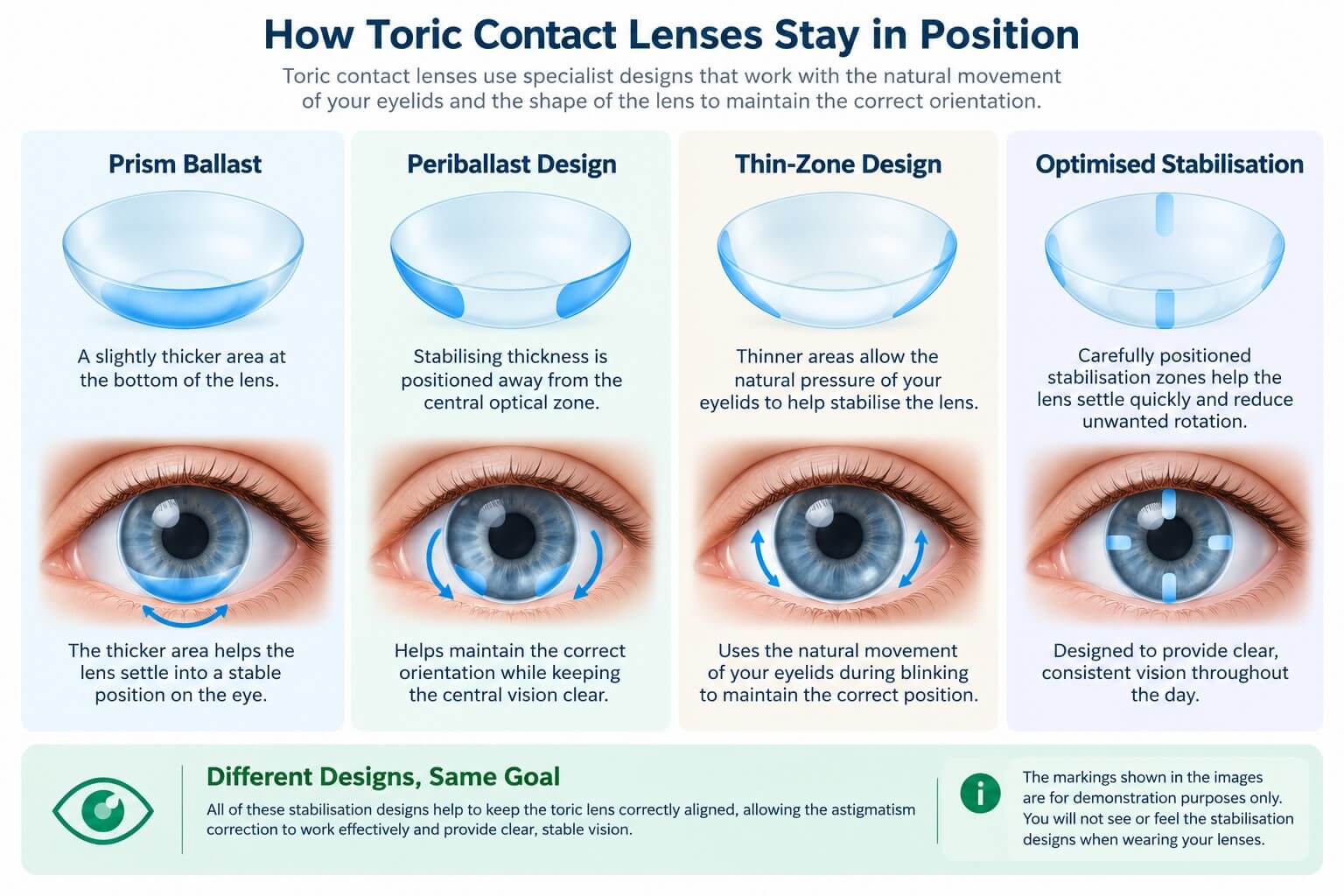
Although these designs work differently, they all have the same aim: to keep the astigmatism correction correctly aligned and provide consistent vision throughout the day.
Why Is the Fit of a Toric Contact Lens Important?
Toric lenses require a little more attention during fitting than standard spherical lenses because their orientation affects how well they correct your vision.
Your optometrist will check how the lens sits on your eye, how much it moves when you blink and whether it rotates away from its intended position.
Sometimes a small adjustment to the prescription or a different lens design can make a noticeable difference to visual clarity and comfort.
You don't need to choose the stabilisation design yourself. Your optometrist will recommend a suitable lens based on your prescription, eye health and how the lens performs during fitting.
Types of Toric Contact Lenses
Toric contact lenses are available in different replacement schedules and materials, allowing people with astigmatism to find an option that suits their prescription, lifestyle, wearing habits, and budget.
Daily Disposable Toric Contact Lenses
Daily disposable toric lenses offer the convenience of a fresh pair every day. Simply insert a new pair in the morning and dispose of them after use, with no cleaning solutions or storage cases required.
They're particularly convenient for occasional wearers, travellers and anyone who prefers a simple contact lens routine. Popular options include 1 Day Acuvue Moist for Astigmatism and Dailies Total 1 for Astigmatism.
Two-Weekly Toric Contact Lenses
Two-weekly toric lenses are replaced every 14 days from opening, according to your optometrist's recommendation. Unlike daily disposables, they must be removed, cleaned and stored in fresh contact lens solution after each day's wear.
ACUVUE OASYS for Astigmatism is an example of a two-weekly toric lens, offering an alternative for people who prefer reusable lenses with a shorter replacement schedule than monthly lenses.
Monthly Toric Contact Lenses
Monthly toric contact lenses are designed to be replaced according to a monthly schedule, rather than after 30 individual wears. They must be removed, cleaned, and stored correctly each evening.
Monthly lenses can be a practical and economical option for people who wear contact lenses regularly. Popular choices include Biofinity Toric and Air Optix for Astigmatism plus HydraGlyde.
Extended Wear Toric Contact Lenses
Some toric contact lenses are approved for extended wear, meaning they may be worn overnight for a specified period when professionally prescribed.
Hydrogel and Silicone Hydrogel Toric Contact Lenses
Toric contact lenses are available in two main soft lens materials: hydrogel and silicone hydrogel.
Hydrogel lenses allow oxygen to reach the eye largely through the water contained within the lens. They are generally soft and flexible, and can provide comfortable vision for many wearers.
Silicone hydrogel lenses also contain water, but the addition of silicone allows significantly more oxygen to pass through the lens to the cornea, without requiring a particularly high water content.
Both materials can provide comfortable vision. The best choice depends on your individual eyes, prescription and how the lens stabilises on your eye.
Can You Get Toric Multifocal Contact Lenses?
Yes. Toric multifocal contact lenses combine correction for astigmatism with multifocal powers to help people who also have presbyopia, the age-related difficulty focusing on close-up objects.
These lenses require an individual fitting to achieve the right balance of vision. For more information, see our guide to Multifocal Contact Lenses.
Understanding Your Toric Contact Lens Prescription
A toric contact lens prescription contains many of the same measurements as a standard contact lens prescription, but it also includes two important additional values: CYL (Cylinder) and AXIS.
These measurements are needed to correct astigmatism and ensure the lens provides clear, stable vision.
At first glance, the numbers and abbreviations can seem confusing. Here's what they mean.
What Do the Numbers on Your Toric Contact Lens Prescription Mean?
| Abbreviation | What It Means |
|---|---|
| SPH (Sphere) | The lens power used to correct short-sightedness (minus numbers) or long-sightedness (plus numbers). If no spherical correction is required, this may be 0.00 (plano). |
| BC (Base Curve) | The curvature of the contact lens, measured in millimetres. |
| DIA (Diameter) | The width of the contact lens, measured in millimetres. |
| CYL (Cylinder) | Shows the amount of lens power needed to correct your astigmatism. It is written as a plus (+) or minus (−) number; the further the number is from zero, the greater the amount of astigmatism being corrected. |
| AXIS | Tells the contact lens where that cylinder correction needs to be positioned. It is measured in degrees from 0 to 180 and describes the orientation of the astigmatism — it is not an indication of how strong your prescription is. |
Understanding CYL and AXIS
The CYL and AXIS values work together to correct astigmatism.
For example, a toric prescription might include CYL −1.25 and AXIS 90.
The CYL value tells you how much astigmatism correction is needed, while the AXIS specifies its orientation.
When ordering toric contact lenses, always enter the CYL and AXIS values exactly as they appear on your current contact lens prescription.
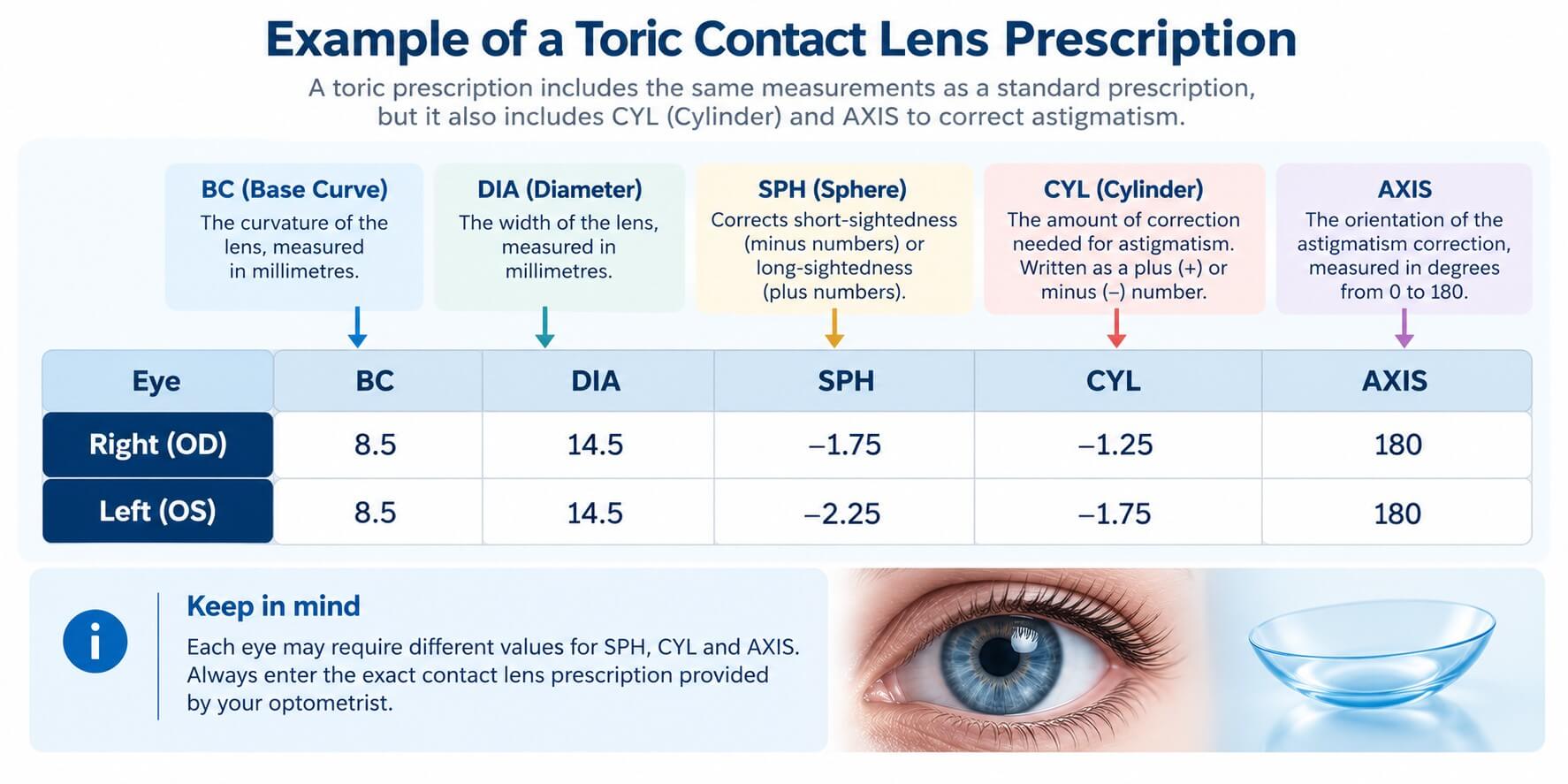
In this example, both eyes require correction for short-sightedness and astigmatism. Although the AXIS is the same for both eyes, the SPH and CYL values are different. This is perfectly normal. Each eye may require a different amount of correction.
Can I Use My Glasses Prescription to Order Toric Contact Lenses?
No. Your glasses prescription and contact lens prescription are not interchangeable.
Contact lenses sit directly on the eye and require additional measurements and a professional fitting. This is particularly important with toric lenses because the lens must remain correctly orientated to provide effective astigmatism correction.
Your optometrist will assess the lens fit, movement and rotation before confirming your contact lens specification.
Always order the exact contact lenses and prescription values specified by your optometrist, rather than changing brands or lens designs yourself.
Which Contact Lenses Are Best for Astigmatism?
Choosing the right contact lenses for astigmatism depends on more than comfort or whether you prefer daily or monthly lenses. Your prescription, eye health and how well the lens stays correctly positioned all play an important role.
Not every toric contact lens is available in every combination of sphere, cylinder and axis, so your prescription may influence which lenses are suitable.
Our recommendations highlight some of the best toric contact lenses for different needs, but your optometrist should confirm which lenses provide the most stable vision, comfortable fit and appropriate correction for your eyes.
Our Recommended Contact Lenses for Astigmatism
| Best For | Contact Lens | Replacement | Why We Recommend It |
|---|---|---|---|
| Best Daily | DAILIES TOTAL1 for Astigmatism | Daily | Combines the convenience of a fresh pair each day with premium comfort-focused materials and stable astigmatism correction. |
| Best Monthly | Biofinity Toric | Monthly | Aquaform silicone hydrogel and Optimised Toric Lens Geometry make it a strong reusable option for regular wear. |
| Best Value Daily | Biotrue ONEday for Astigmatism | Daily | An affordable daily disposable toric lens with a high-water hydrogel material. |
| Best Value Monthly | Avaira Vitality Toric | Monthly | A competitively priced silicone hydrogel toric lens, offering good value for regular wearers. |
| Best for Active Lifestyles | ACUVUE OASYS 1-Day for Astigmatism | Daily | Its Blink Stabilized design uses the natural pressure of the eyelids during blinking to help the lens settle quickly and maintain stable vision. |
| Best Overall | DAILIES TOTAL1 for Astigmatism | Daily | Premium water-gradient design, breathable silicone hydrogel and stabilisation features intended to provide clear, consistent vision. |
These recommendations are intended as a guide. Individual comfort and visual performance vary, and toric contact lenses should always be professionally fitted.
How Much Do Toric Contact Lenses Cost?
The cost of toric contact lenses depends on the brand, lens material and replacement schedule. Both daily disposable and monthly toric lenses are available at different price points, making it possible to find an option that suits your prescription and budget.
Daily disposable toric lenses offer the convenience of a fresh pair every day, while monthly toric lenses are generally more economical for people who wear contact lenses regularly.
How Much Do Daily and Monthly Toric Contact Lenses Cost?
The table below shows examples of toric contact lens prices and their approximate cost per day when worn in both eyes.
| Contact Lens | Replacement | Price per Box | Cost per Day (Both Eyes) |
|---|---|---|---|
| Biotrue ONEday for Astigmatism | Daily (30 lenses) | £30.00 | £2.00 |
| 1 Day Acuvue Moist for Astigmatism | Daily (30 lenses) | £32.99 | £2.20 |
| Avaira Vitality Toric | Monthly (3 lenses) | £24.00 | £0.53 |
| Biofinity Toric | Monthly (3 lenses) | £28.07 | £0.62 |
Daily disposable costs assume two lenses per day. Monthly costs are averaged over approximately 90 days for both eyes and exclude cleaning solutions and cases. Prices may change.
Are Daily or Monthly Toric Contact Lenses Better Value?
Monthly toric lenses are generally more economical for everyday wear, although cleaning solutions and storage cases add to the overall cost.
Daily disposable toric lenses cost more per day, but they require no cleaning or storage. They can be particularly good value for occasional wearers because you only use a fresh pair on the days you need them.
The best value isn't necessarily the lowest price. Your toric lenses must provide clear, stable vision, fit comfortably and be suitable for your prescription.
Getting Used to Toric Contact Lenses
Most people adapt to wearing toric contact lenses quite quickly, particularly if they've worn contact lenses before. However, if you're new to contact lenses or switching from standard spherical lenses, it may take a little time to become comfortable handling them and adjusting to your new vision.
Toric lenses are designed to settle into the correct position on your eye. You may occasionally notice a brief change in clarity immediately after inserting your lenses or blinking, but your vision should settle and remain consistently clear once the lenses are correctly positioned.
Tips for Getting Used to Toric Contact Lenses
- Follow your optometrist's wearing schedule. If you're new to contact lenses, you may be advised to build up your wearing time gradually.
- Allow your lenses to settle. Toric lenses may need a short time to orientate correctly after insertion. Your vision should become clear and stable once they're in position.
- Pay attention to changes in vision. If your vision regularly becomes blurred or fluctuates when you blink, your lenses may not be maintaining the correct orientation. Ask your optometrist to check the fit.
What If Your Toric Contact Lenses Feel Uncomfortable?
Modern toric contact lenses are designed to provide comfortable, stable vision, and most wearers should not be constantly aware of their lenses.
Mild awareness of a new lens should improve as you become accustomed to wearing it. However, persistent discomfort, recurring blurred vision or a lens that repeatedly moves out of position should not simply be accepted as part of the adjustment period.
Your optometrist may be able to improve your vision and comfort by adjusting the prescription or recommending a different toric lens design.
Our Optometrist's Advice
“Toric contact lenses need to be professionally fitted, rather than simply matched to the numbers on your prescription. Two lenses with the same power, cylinder and axis can behave quite differently on the eye, so it's important to check how well the lens sits, moves and maintains its position.
Sometimes a small adjustment to the prescription or a different lens design can make a noticeable difference to the clarity and stability of your vision.
Once you've been fitted, always order the lenses specified by your optometrist, and seek their advice before changing to another brand or type.”
John Dreyer, Bsc(Hons), MCOPTOM, DipCLP
Optometrist & Clinical Content Reviewer
Frequently Asked Questions About Toric Contact Lenses
Can I Wear Contact Lenses If I Have Astigmatism?
Yes. Most people with astigmatism can wear contact lenses. Toric contact lenses are specifically designed to correct astigmatism and are available in daily disposable, two-weekly and monthly options.
Your optometrist can assess your prescription and recommend a suitable lens.
Are Toric Contact Lenses More Difficult to Wear?
No. Once properly fitted, toric contact lenses are generally just as easy to wear as standard contact lenses.
They may take a short time to settle into the correct position after insertion, but they should provide clear, stable vision throughout the day.
What Do CYL and AXIS Mean on My Contact Lens Prescription?
CYL (Cylinder) indicates the amount of correction needed for your astigmatism. The further the value is from zero, the greater the correction required.
AXIS indicates the orientation of that correction, measured in degrees from 0 to 180. It doesn't indicate the strength of your prescription.
Both measurements are needed to ensure your toric contact lenses provide the correct vision.
Can You Sleep in Toric Contact Lenses?
Most toric contact lenses should be removed before sleeping. Some are approved for extended wear, but overnight use should only be considered when specifically prescribed by your optometrist.
Sleeping in contact lenses increases the risk of serious eye infections, even with lenses approved for extended wear.
Can You Wear Toric Contact Lenses for Sports?
Yes. Toric contact lenses can be a good option for many sports because they provide a wider field of vision than glasses and won't slip down your nose.
Modern stabilisation designs help maintain clear vision during movement. Daily disposable toric lenses can be particularly convenient for sport and occasional wear.
Avoid wearing contact lenses when swimming or taking part in water sports where your lenses may come into contact with water.
Can I Wear Toric Contact Lenses If I Have Dry Eyes?
Many people with mild dry-eye symptoms can successfully wear toric contact lenses, although the choice of lens material, replacement schedule and fit can make a difference.
Your optometrist can assess the cause of your symptoms and recommend suitable lenses or treatment. Persistent dryness or discomfort shouldn't simply be ignored.
Can You Get Coloured Toric Contact Lenses?
Yes, coloured toric contact lenses do exist, but they're much less widely available than standard coloured contact lenses and are not generally offered by the major contact lens manufacturers.
Coloured toric contact lenses for astigmatism still require a professional contact lens fitting, even if you only want to change your eye colour. Never purchase them without appropriate professional advice.
